Be Kind to Everyone T-shirt Designs: Graphics for Crafts & Branding
As a graphic designer who’s built visual identities for handmade businesses, local nonprofits, and seasonal print-on-demand collections over the past 12 years, I recently evaluated Be Kind to Everyone T-shirt Designs for a real client project: a spring wellness pop-up shop launching a limited-edition apparel + tote line. My goal wasn’t just to assess aesthetics—it was to determine whether this asset could function as a reliable, versatile, and commercially sound element across packaging, social media graphics, product mockups, and in-store signage.
A Warm, Approachable First Impression—Not Just Cute, But Cohesive
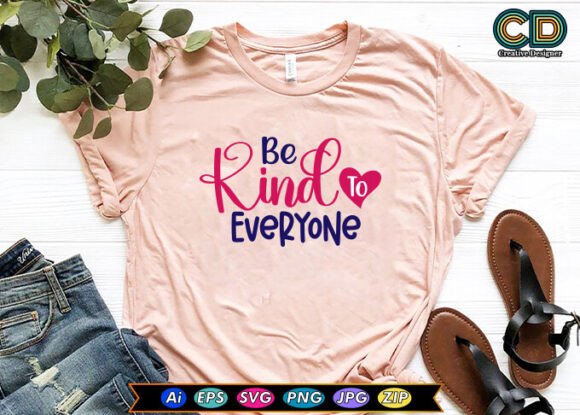
The core phrase—“Be Kind To Everyone”—lands with quiet confidence. It’s not shouty or overly decorative; it uses soft weight contrast, gentle letter spacing, and subtle organic texture that reads as hand-crafted without sacrificing legibility. The mood is inclusive, calm, and human-centered—ideal for brands rooted in mindfulness, education, community care, or slow-living values. Visually, it sits comfortably between modern design and heartfelt handmade business aesthetics. It doesn’t scream “trend,” which means it won’t date quickly—and that matters when designing for an Etsy product or a boutique’s year-round merch line.
Where This Graphic Design Asset Truly Shines
- Product mockups: Works exceptionally well on t-shirt, mug, and tote bag templates—especially with natural fabric textures or matte finishes. The balanced weight holds up in lifestyle photography without competing with background elements.
- Social media graphics: Scales beautifully for Instagram posts and Pinterest pins. Paired with neutral or earth-toned palettes, it reinforces emotional appeal while supporting clear visual hierarchy.
- Cricut projects & sticker design: The included SVG and EPS files are cleanly constructed—no stray anchor points or hidden layers. I tested it on vinyl cutters and sublimation blanks; registration stayed sharp even at 3" width.
- Printable design & editorial use: As a decorative accent in digital planners, workshop handouts, or printable wall art, it adds warmth without overwhelming content.
- Brand identity support: While not a logo replacement, it functions powerfully as a secondary brand element—think campaign tagline, packaging detail, or website banner reinforcement for small business branding.
Real-World Use Cases That Benefit Most
This isn’t a one-size-fits-all clipart solution. It excels in contexts where emotional resonance matters more than clinical precision: a yoga studio’s seasonal tee drop, a teacher’s classroom kindness initiative, a mental health nonprofit’s awareness campaign, or a craft fair vendor’s curated gift set. In those scenarios, Be Kind to Everyone T-shirt Designs helps unify tone across touchpoints—from Canva templates used by non-designers to professionally printed hang tags and Instagram Stories.
Where to Proceed With Intentional Design Judgment
It’s less effective in minimalist corporate branding, dense infographics, or ultra-thin type environments (e.g., fine-print legal disclaimers). Avoid using it at under 18pt in small-format packaging or alongside high-contrast photographic backgrounds unless you’ve verified transparency integrity in the PNG file. Also, don’t assume it pairs seamlessly with every font family—test it next to your brand’s primary serif, sans serif, and script fonts. I found it harmonized best with warm, open sans serifs (like Montserrat or Poppins) and gentle handwritten accents—not tight geometric displays or heavy monospace fonts.
Practical Designer Notes Before Client Deployment
- Test black-and-white output: Confirm readability in grayscale for embroidery digitizing or monochrome print runs.
- Check contrast on light/dark backgrounds: The transparent PNG delivered clean edges—but always preview on actual mockup backgrounds, not just white canvas.
- Validate vector editability: Open the AI and SVG files in Illustrator and Affinity Designer—verify stroke consistency, text conversion status, and layer organization before handing off to a developer or printer.
- Review commercial license terms: Confirm usage rights cover your client’s distribution model—especially if they’re selling via print-on-demand platforms or bundling into a digital product like a Canva template pack.
- Assess scalability: Zoom in at 400%—look for pixelation in JPGs, aliasing in SVG exports, or jagged curves in EPS previews.
Final Verdict: A Thoughtful, Flexible Creative Design Asset
In my current client project—the wellness pop-up—I’ve integrated Be Kind to Everyone T-shirt Designs across three key areas: as the central motif on eco-cotton tees, as a foil-stamped detail on recycled kraft gift boxes, and as a recurring visual motif in their Instagram carousel ads. Each application feels intentional, emotionally grounded, and professionally executed—not generic or templated. It supports, rather than overshadows, the brand’s voice.
That said, its strength lies in context-aware deployment. It’s not a logo design substitute, nor is it built for technical precision like engineering schematics or data visualization. But as a graphic design asset for crafts, small business branding, and emotionally intelligent marketing visuals? It delivers consistent quality, thoughtful execution, and genuine versatility across digital product, printable design, and physical merchandise workflows.
If your client values authenticity over flash, warmth over trend-chasing, and cohesion over clutter—this is a design bundle worth keeping in your active toolkit.