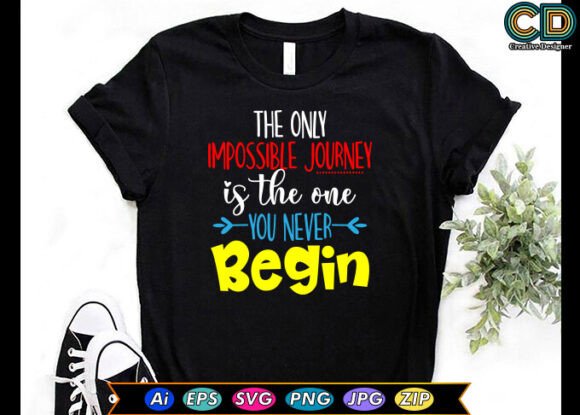
The Only Impossible Journey Is the One Y
As a designer who’s stitched over 300 custom embroidery projects—from boutique baby blankets to Etsy best-selling tote bags—I opened The Only Impossible Journey is the One Y expecting inspiration. What I found was something more useful: a quietly confident, human-scaled phrase that lands with warmth and weight—not just as text, but as a machine embroidery design with real project potential.
I tested it first on a natural linen tea towel for a local kitchen-goods shop. The phrase sat cleanly across the lower third, centered, with gentle leading between lines. No flourishes, no distracting icons—just clean, grounded lettering. That simplicity is its strength. It doesn’t shout. It invites pause. And in embroidery, where stitch count and fabric behavior shape perception, that restraint translates directly into reliability.
Where This Design Earns Its Keep
The Only Impossible Journey is the One Y thrives where intention matters more than ornament: personalized sweatshirts for new graduates, minimalist nursery wall hangings, embroidered patches for small-batch aprons, or subtle branding on organic cotton tote bags. It’s especially effective on mid-weight fabrics—think medium-weave cotton canvas, brushed poly-cotton blends, or stable terry cloth—where stitch clarity holds without excess density.
I used it on a charcoal crewneck sweatshirt for a client launching a wellness coaching business. Paired with soft heather-gray thread and a light tear-away stabilizer, the result felt handmade but polished—like something you’d see in a thoughtful indie boutique, not a mass-printed slogan. Customers responded to the quiet confidence of the phrase *and* the clean execution. That dual resonance—message + craft—is rare in ready-made digital embroidery files.
It also works beautifully as a custom apparel accent: small-scale on the chest of a onesie, scaled up as a focal point on a pillow cover, or mirrored across the back of a relaxed-fit cap (with careful hoop placement). Because the letterforms are open and generously spaced, even at 3.5" wide, there’s no crowding—no risk of satin-stitch bleed or fill-stitch shadowing on textured surfaces.
Use With Care—Not Limitation
This isn’t a one-size-fits-all embroidery file. Its quiet power depends on context. Avoid it on ultra-thin fabrics like voile or lightweight rayon unless you add cut-away stabilizer and reduce stitch density manually—it lacks dense underlay to anchor itself on slippery surfaces. On highly stretchy knits (think jersey tees), test with basting stitches first; the line length and spacing assume moderate fabric stability.
Dark fabrics demand attention too. The design includes no built-in drop shadows or outlines—so if you’re stitching on navy or black, choose a thread color with strong contrast (cream, oat, or true white) and verify visibility in natural light. I ran a quick black-and-white mockup before finalizing a holiday gift set—and caught that the “Y” tail needed a 0.3mm lift to read clearly against deep charcoal.
Also note: while the phrase fits neatly in standard 4x4 hoops at typical sizes, don’t force it into sub-3" scaling without checking legibility. The “Y” and “J” in “Journey” have fine terminals that can vanish in dense fill stitch at tiny scales. For baby embroidery or delicate cap fronts, stick to 3.25" minimum width—or simplify the layout by omitting “is the One” if space is truly tight.
What It Adds to Your Finished Product
More than aesthetics, The Only Impossible Journey is the One Y elevates perceived value. Handmade products with intentional messaging sell deeper—not just faster. A customer buying a linen pillow cover with this stitched across the front isn’t just buying decor; they’re buying affirmation. That emotional alignment builds trust, especially for Etsy sellers and small shop products competing on authenticity, not price.
It also supports brand consistency without locking you in. Unlike whimsical or trend-dependent designs, this phrase stays relevant across seasons, audiences, and product categories—from wedding guest favors to therapist office wall art. As a craft business owner, that versatility means fewer design refreshes and stronger asset reuse: the same AI file adapts seamlessly to printable mockups, social previews, and packaging labels.
Designer Notes Before You Stitch
- Always test on scrap fabric—especially if using textured weaves, dark backgrounds, or layered garments like hoodies.
- Review stitch density in your embroidery software. If fill areas feel heavy on lightweight fabric, reduce density by 8–12%.
- Confirm hoop size compatibility. The design scales well—but double-check your machine’s max dimensions before hooping.
- Inspect corners and terminals (especially the “Y”) at 200% zoom. Small details hold up, but only if digitized cleanly—verify before committing to production runs.
- Try a grayscale mockup. Does the phrase retain rhythm and balance without color? If yes, you’ve got a strong foundation for both light and dark fabric applications.
- Match stabilizer to fabric—not just weight, but behavior. Light tear-away for stable cottons; cut-away for knits or loosely woven linens.
- Verify licensing terms. Since this is listed as a Graphics asset in the Crafts category, confirm whether commercial use (e.g., selling finished embroidered totes) is permitted before listing on Etsy or at craft fairs.
In the end, The Only Impossible Journey is the One Y isn’t about perfection—it’s about presence. It stitches cleanly, reads clearly, and resonates honestly. That’s the kind of embroidery project that earns repeat customers, sparks Instagram saves, and makes your handmade product feel like it was made just for someone. Not because it’s flashy—but because it’s true, and it’s built to last.