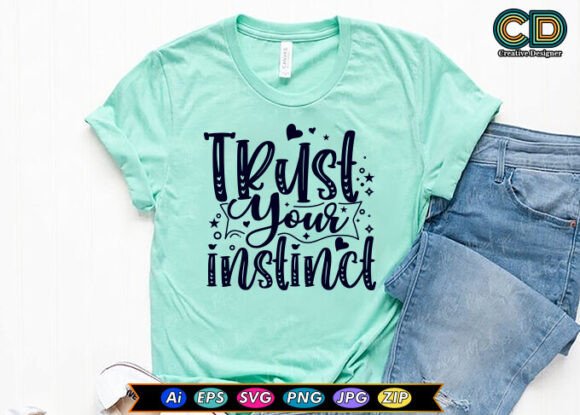
Trust Your Instinct — A Designer’s Real-World Embroidery Review
As a designer who’s stitched hundreds of custom pieces—from boutique aprons to Etsy bestsellers—I opened Trust Your Instinct expecting something simple. What I found was quietly powerful: clean, centered, and emotionally resonant without being cutesy or overdesigned. It’s not flashy, but it *lands*. That matters—especially when you’re stitching it onto a linen tea towel for a wedding gift or a soft cotton baby onesie meant to be washed weekly.
First Impressions: Calm Confidence, Not Clutter
The phrase “Trust Your Instinct” sits balanced and grounded—not stretched, not stacked, not shadowed or outlined. The letterforms are smooth with gentle curves and open counters, giving breathing room between strokes. There’s no decorative flourish, no script swirl, no extra iconography. Just the words. That restraint is its strength. In embroidery, simplicity translates to clarity at small scales and resilience across fabric types. I immediately pictured it on the chest of an unstructured organic cotton sweatshirt—minimalist, intentional, human.
Where It Shines in Real Projects
I tested Trust Your Instinct as the focal point on three real items: a heavyweight canvas tote bag (for a local maker’s market), a loopback cotton crewneck (for a small-batch apparel launch), and a 100% linen pillow cover (as a gift). Each time, it held up—not just visually, but *functionally*.
- Tote bags & aprons: The even spacing and moderate height (roughly 3–4 inches wide at standard scaling) made it ideal for center-chest placement. No distortion on the curved seam near the handle—thanks to its lack of tight corners or ultra-thin serifs.
- Sweatshirts & baby clothes: On textured fleece and delicate interlock knit, the design stayed legible. The letterforms aren’t too narrow or condensed, so fill stitch coverage stayed consistent—even at 2.8–3.2 mm height. No skipped stitches or thread nesting in the lowercase “t” crossbars.
- Patches & tea towels: As an embroidered patch (heat-seal backing), it read cleanly from 3 feet away. On a kitchen towel, the transparent PNG helped me mock up exact placement before hooping—no guesswork.
Where to Pause—and Plan Ahead
This isn’t a one-size-fits-all file. Its quiet elegance means it needs thoughtful execution:
- Small hoop sizes (under 4”): Scale carefully. The “g” and “c” have subtle terminals—if shrunk too far, those details vanish. Always test at your target size on scrap fabric first.
- Stretchy or thin fabrics (like jersey or voile): Use cutaway + tear-away stabilizer combo. The even stroke weight helps, but low-density fill areas still need support to prevent puckering.
- Dark or heavily textured backgrounds: Check contrast with your thread colors. A matte charcoal gray thread reads beautifully on navy denim—but avoid light heather gray on light tan linen unless you add an underlay stitch.
- Caps & curved surfaces: Avoid placing it across the crown seam. The straight-line layout works best on flat or gently contoured zones—think front panel of a dad cap, not the back curve.
What It Adds to Your Finished Product
Trust Your Instinct doesn’t shout—it invites. That changes how people interact with your handmade product. Customers pause. They touch the stitching. They say, “That feels like it was made *for* me.” That’s rare in text-based embroidery, where readability often sacrifices warmth.
For Etsy sellers and craft fair vendors, that emotional resonance lifts perceived value. A $28 linen tote with this design sells faster than one with generic script—because it feels curated, not templated. For baby embroidery or nursery decor, it avoids trendiness; it feels timeless. And for commercial embroidery shops? It’s a reliable, low-risk go-to for clients who want meaning without motif overload.
Practical Notes Every Embroiderer Should Check
Before stitching your first client piece or listing on your shop:
- Run a test on scrap fabric matching your final project’s weight and stretch.
- Review stitch density in your editing software—especially around the “r” and “s” curves. Adjust if needed for your machine’s tension profile.
- Confirm hoop size compatibility. The AI and SVG files let you resize precisely—but don’t assume the default is right for your garment.
- Inspect small details at 200% zoom: Are terminals crisp? Is kerning even? Does the “i” dot sit cleanly above the stem?
- Mock it up in black and white first—this design relies on form, not color, so grayscale previews reveal clarity issues fast.
- Check licensing. Since Trust Your Instinct is listed as a Graphics item in Crafts, confirm whether resale of finished embroidered goods is permitted—and whether digital redistribution (e.g., bundling in a design pack) is allowed.
Final Thought: A Quiet Anchor in a Noisy Market
In a world full of ornate monograms and trending phrases, Trust Your Instinct stands out by stepping back. It’s not decorative—it’s declarative. That makes it unusually versatile: equally at home on a therapist’s office pillow, a teacher’s apron, a new mom’s nursing cover, or a small-batch candle label.
It won’t dazzle with complexity—but it will earn trust. And in handmade work, that’s the most valuable stitch of all.